
Webinars › Beyond the Journal
Free webinar recordingChildren's books as knowledge mobilization, and how grants can fund them.
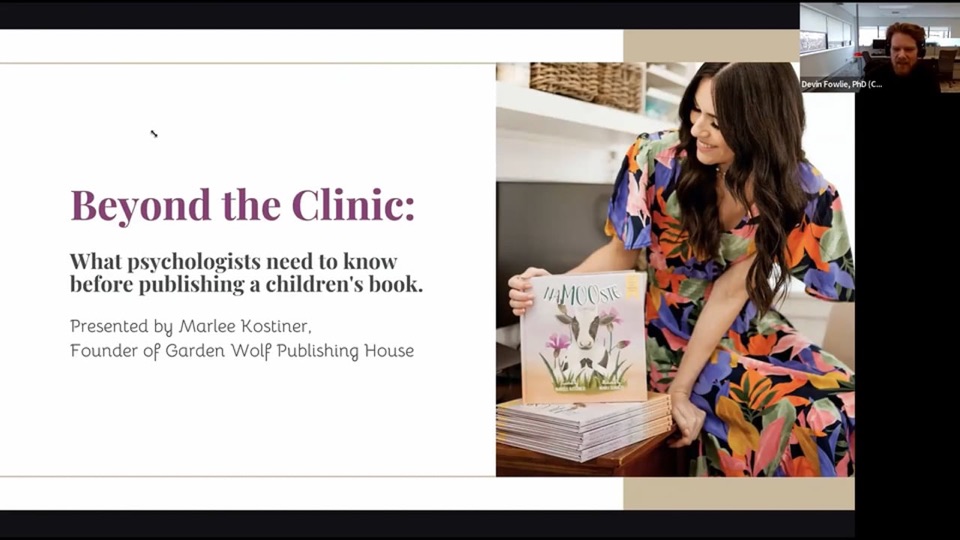
Your research can reach the children, families and classrooms it's about, well beyond the readers of a journal. In this session for the Canadian Psychological Association, Marlee Kostiner and Dr. Jodie Gawryluk walk through how a children's book fits into a grant, from the first idea to the budget line.
 Host
Marlee Kostiner
 Guest
Dr. Jodie Gawryluk
Presented to the Canadian Psychological Association · Recorded October 30, 2026 · Guest: Dr. Jodie Gawryluk, University of Victoria
Why a book counts as knowledge mobilization, where the funding comes from, what goes in the budget, and a conversation with a researcher whose book is in production.
Recorded October 30, 2026. The November 2 deadline mentioned in the recording has passed. The next SSHRC Connection Grant deadlines are February 1 and May 3, 2027.
Jump to a chapterA second path beyond the journal article, made for the children, families and classrooms your research is about.
Funders ask about both. Before-and-after surveys can measure a book's impact, often with free university tools.
As a line item, as the centre of a knowledge mobilization project, or by reallocating funds from a grant you already hold.
SSHRC, CIHR, arts councils, provincial programs, nonprofit foundations and internal university funds.
Every grant has its own rules. How the line items change from grant to grant, and lower-cost options when printing isn't covered.
Dr. Jodie Gawryluk on turning community-engaged dementia research into a picture book.
You're planning a grant application, or you hold a grant and want your findings to reach families and schools.
Most grants need a faculty applicant, so the session covers how to plan a book with your supervisor.
You help researchers find knowledge mobilization ideas that funders can see and count.
Psychologists, nurses and health professionals who teach, publish or work on research teams.
Clinical neuropsychologist and professor, University of Victoria · Director, Institute on Aging and Lifelong Health
Jodie found Garden Wolf through Marlee's first CPA webinar in May 2026. Her picture book grew out of community-engaged dementia research: the people she worked with asked for intergenerational education, and that became part of an SSHRC Insight Grant, with before-and-after surveys built in.
In the webinar, she talks about how she and Marlee split a grant application (Jodie wrote the background, Marlee the budget, plan and timeline), how she tailors each application to the funder, and why it's worth applying again.
Founder, Garden Wolf Publishing House
Marlee spent over two decades as a journalist, editor and writer before founding Garden Wolf Publishing House in Montreal. Her own picture book, NaMOOste, sold 1,000 copies through grassroots marketing.
Garden Wolf now makes children's books with psychologists, clinicians and researchers, including books funded through knowledge mobilization grants. Marlee can help with the budget, plan and timeline for your application.
Book a free call to talk through your idea, which funding could fit, and what a budget could look like.
Book a free callOften, yes. A children's book can be a line item in a grant application, the centre of a knowledge mobilization project, or funded by reallocating part of a grant you already hold. Every grant has its own rules, so the budget is built for the specific funder.
SSHRC is often the best fit for social sciences research, for example through Connection Grants or Partnership Engage Grants. Health research may fit CIHR knowledge translation funding. Arts councils, provincial programs, nonprofit foundations and internal university funds are also options.
February 1 and May 3, 2027. Your university's research office usually sets an internal deadline two to three weeks earlier, so check with them first.
SSHRC doesn't fund projects whose main goal is a stand-alone book. Describe the outreach first (workshops, community sessions, educational outreach) and present the book as the educational aid that supports it.
Yes, with a faculty member. Students usually can't be the applicant, so talk to your supervisor and plan the application together.
Keep citations out of the story itself. They can go in footnotes, activity pages or back matter at the end of the book.
Put the funder's logo on the back cover and a note on the copyright page. A book can carry several funder logos.
No. Garden Wolf helps with concept development, editing and ghostwriting, so you can focus on what your research needs to say.
No. For knowledge mobilization, impact matters more than revenue. Many researchers give their books away to families, schools and clinics.